Ball of Confusion avatar

Manchester and the way back: The Death of Huskisson, Part 3

What happened to the trains when they arrived in Manchester and how they got back to Liverpool.
I first wrote this account in 2017 on the build2understand blog on Silvrback under the *nom de plume* ed3d. This version has not been further updated as yet. The markdown support also varies between platforms so there may be issues that need fixing. Please bear with me.

There is even more conjecture here than normal. Many accounts written at the time and since are partial, evasive or both, Rolt being an exception in his biography of the Stephensons which, like this post, derives somewhat from a collection of anecdotes and reportage.

For those playing catch-up: Part 1, Part 2.

As a reminder, the ducal train was on the southern track pulled by Northumbrian. The seven trains on the northern track running into Manchester Liverpool Road station were drawn by Phoenix, North Star, Rocket, Dart, Comet, Arrow and Meteor and were pulling a total of 24 carriages.

From Parkside to Manchester

For the passengers on the eight trains making up the inaugural procession on the Liverpool & Manchester Railway, the severe injury to Huskisson and a change in the weather had dampened spirits and more. The crowd waiting for the trains to pull into Manchester extended some four miles up the line and was by no means entirely welcoming. Progress was slowed by track incursions that incidentally threw wet sand over the carefully cleaned tracks. The 59th Regiment were in attendance in addition to the railway and civil policemen but the crowd was immense and contained unruly elements.

The social and political context

The people of Manchester had multiple issues with the ultra-Tory Prime Minister, the Duke of Wellington, including electoral reform (Manchester returned no MPs at this time and the franchise generally was limited) and concern over the railway taking jobs from other transport sectors such as canals and coaching. The living and working conditions of those employed in mills and mines were poor and the owners frequently exploitative. As we have seen, there was also a history of dissent being repressed by violent means. Some among the crowd chose to express their discontent vocally, by holding-up banners and placards, by wearing revolutionary cockades (thoughtfully provided gratis by a local newspaper) and by throwing stones. The atmosphere was very different from Liverpool and doubtless exactly what the Duke had feared.

The crowd at Manchester

The arrival of the procession was signalled by the firing of a cannon, the sound being heard by the mortally injured Huskisson at Eccles some 4-5 miles away. As the engines were due to be serviced again there later, this may have been as much a signal as ceremonial although it provoked Huskisson to express concern for the Duke’s safety. For the crowd near the station it might have been perceived as a starting pistol.

Many who had come to see the trains would have been just plain curious and hoping for a sight of the famous Duke above all else, something they could tell their children and grandchildren about in years to come. The extent of the crowd, however, meant that police and military cordons became severely over-stretched and as a consequence the crowd surged through and accessed locations supposedly off-limits such as the track and station.

These people, of course, enjoyed the best view of the engines, coaches and celebrity passengers cooped somewhat anxiously in their gilded carriages. More broadly they probably also valued the opportunity to see Manchester, the adjacent Salford and, of course, the crowds, from the elevated vantage point of the track. Whether politically motivated or not, there was much to see.

The passengers

The consequences for the trains was, however, serious. While the ducal train may (unusually) have run into the station using the normal departure track, the seven trains on the northern line were likely backed off a little and strung out at least as far back as the bridge over the River Irwell. It is probable that they stopped at specific locations where specially positioned turnplates permitted engines to cross to and from the adjacent track. Passengers were supposed to walk to the station and ascend a specially constructed staircase to the first floor of the new goods warehouse where a cold collation awaited them. The ladies were also provided with a withdrawing room at the far end.

How many braved the crowds is not known. Certainly the Duke remained in his carriage resolutely shaking hands with both arms and on occasion even kissing babies as politicians for some reason do. He and his elite co-passengers presumably had sustenance ferried to them. Some of the Directors' wives did descend, however, as we know that the wife and family of John Moss were subsequently left behind. Coordination between trains now became difficult or impossible.

The train and engines

Trains usually dropped their passengers before traversing the Water Street bridge but let us assume that the ducal train pulled into the station on the line normally used for departures and that Northumbrian would subsequently use turnplates on the track to cross to the adjacent line and run round to the front. It’s possible that it first dropped off the band car that had been used as a makeshift ambulance for Huskisson but was no longer serving any useful purpose as the band had left the train at Parkside.

Meanwhile Dart, Comet, Meteor and lastly Phoenix deserted their trains, crossed to the southern line (presumably by means of turnplates) and ran to Eccles to pick-up water. The fact that Phoenix left suggests that the action was sanctioned by Stephenson who was nearby in the ducal train. The engines were therefore following a pre-determined plan with the departing locomotives expected to return before the second cohort repeated the operation (as they would do subsequently).

At one level, of course, it was entertaining for the crowds to see the locomotives in motion. However, it had the additional benefits of sweeping the crowd back from the eventual path of the ducal train and reducing the possibility of sabotage of the expensive engines by any Luddite tendency among the crowd.

An alternative (conspiracy) theory

If you like conspiracy theories, there was another possible issue with Eccles beyond watering and the deeply ailing Huskisson. Earlier in the day the vicar’s wife, Mrs Blackburne, had heard that men from Oldham were planning to descend on Eccles to attack the trains and she assisted in summoning local special constables to protect three miles of adjacent track. Stephenson may have heard of this problem and sent the engines as a reconnaissance in force to check that there would be no interference with the ducal train as it stopped for water (although it is possible that Northumbrian had been replenished during its earlier visits to Eccles).

Accelerated departure of the ducal train

Unfortunately, the decision was then taken to have the ducal train leave Manchester at short notice at 16:37 as the Deputy Chief Constable was no longer able to guarantee the safety of the party and the Duke in particular. The DCC was one Stephen Lavender who had been a principal detective in London’s Bow Street Police Office and was likely experienced in close protection. Lavender had had a distinguished career in London and has appeared since as a character in a number of historical crime novels.

Unfortunately we don’t know what specific intelligence framed the decision and whether it applied specifically to the situation in the station or, as seems more likely, to the restive crowd outside who had not had their “turn” (whatever that might involve). In addition a “buffer” of local dignitaries and well-to-do families may now have moved away allowing more dubious groups and individuals to get closer to the Duke. Perhaps Lavender had it in mind that one Prime Minister, Spencer Perceval, had already been assassinated in 1812 and he was determined to avoid the possibility of a repeat here. Doubtless Peterloo also weighed heavily on minds.

Whatever the cause, it was the presence of the ducal train that was the inciting trigger and Lavender’s gut instinct presumably told him that its departure would help defuse the situation as well as protect the Duke. Overall, however, the Duke’s reluctance to continue to the city had been proven well-founded.

No way back from Eccles

By this time the other engines now on the southern line were on their way back from Eccles. As there was no turning place (these had been specifically removed for safety reasons as far as Huyton, possibly under Gooch’s orders), they were forced to reverse to run ahead of the ducal train although Phoenix hung back to act as pilot for Northumbrian. Pilot in this context implied inspecting the line for obstructions.

Night fell around 19:00 and the trains improvised by using burning tarred rope to light the way.

The Duke had been scheduled to attend a celebratory dinner in Liverpool but under the circumstances detrained at Roby around 19:30 whence he travelled to Childwall Hall where he was the guest of the Marquess of Salisbury.

Meteor, Comet and Dart meanwhile raced to Huyton where they transferred to the northern line and headed back towards Manchester.

The remaining trains combine at Manchester

In the absence of the apparently errant engines the decision was taken to combine the remaining carriages and engines into one train comprising three locomotives (North Star, Rocket and Arrow) and no fewer than 24 carriages. According to Rolt, however, the engines first went to Eccles for water which must have been an incredibly dispiriting sight for the bewildered passengers left behind (and perhaps takes some shine off the conspiracy theory).

Once the engines returned, they transferred to the northern track and the carriages were shunted together. Once started sometime after 17:00, the progress of the aggregated train was, unsurprisingly, slow, typically 5 mph. There is some suggestion that they paused at Eccles again, perhaps asking after Huskisson (whose condition was beyond hope; he died around 21:00), as some couplings failed there on restarting.

Subsequently they met the three returning engines on the northern line at Parkside, the three having travelled an extra 31 miles from Eccles via Huyton to Parkside. This is the same distance as from Manchester to Liverpool so presumably they picked up additional water and fuel while at Parkside. Dart and Comet (which was leading on the way back and hit a wheelbarrow maliciously placed on the track without derailing) were joined to the train with Meteor (formerly in the rear of the group) now running in advance as pilot.

The passage up the Sutton incline, however, proved too much even with additional engines and gentlemen were asked to dismount and walk alongside the carriages in the dark until the Rainhill Level was reached. The rain was not helping.

Journey’s end

On arrival at Edge Hill at 22:00 the combined train would have been split to allow passage of groups of carriages (4-6?) down through the long tunnel to the docks where horse carriages would be waiting patiently to take them home, the “celebratory” dinners in Liverpool having already concluded. There is some suggestion that passengers cheered as they made their way down the tunnel. Whether their calls were answered by those at the docks or by their own echo is uncertain.

It is unclear whether the engines in the Moorish Arch were yet in use or whether this was a simple gravity run with extra breaking provided by pilot wagons. On balance the coupled return of carriages to Edge Hill from the docks powered by the engine in the Arch seems more likely despite evidence from prints that one of the chimneys had yet to be finished.

The last passengers detrained at 23:00.

Looking back

In principle the journey could have taken 5 hours allowing 2 hours stay in Manchester and, indeed, the arrival in Liverpool had been scheduled for 16:00. In practice it had taken a gruelling 11 hours for which the passengers were largely unprepared. Of course, the notion of a day-trip to Manchester for 700-plus people would have been inconceivable prior to the advent of the railway.

From a contemporary vantage-point, the journey had been a nightmare and at the time the newspapers and railway critics made much of the death of Huskisson. Conversely the actor Fanny Kemble mentions in her memoirs how quickly she became emotionally detached from the terrible events of that day. These were, of course, times in which travel delays due to prevailing winds or icy roads were the norm and shipwrecks not uncommon.

As far as the company was concerned, the human cost of their enterprise had already been made apparent as just the previous week one of the assistant engineers had died in an accident. The onus on them was to provide a return for their investors and to exploit any competitive advantage for all it was worth. Significant though the (relatively) successful opening had been, vindication remained for the future. Their eventual success can be judged not only by the global railway system but by the surviving artefacts of that first run, not least Liverpool Road station (now part of the Museum of Science & Industry) and Huskisson’s nemesis, the Rocket (in the Science Museum, London).
Hulton of Hulton: The Death of Huskisson, Part 2

What happened after George Stephenson departed Parkside and some background on one of the key players, Hulton of Hulton.
I first wrote this account in 2017 on the build2understand blog on Silvrback under the *nom de plume* ed3d. This version has not been further updated as yet. The markdown support also varies between platforms so there may be issues that need fixing. Please bear with me.

After the tragic death of Huskisson

Previously we looked at the events leading up to the accident to William Huskisson MP at Parkside during the opening of the Liverpool & Manchester Railway in 1830.

We will not follow Stephenson’s furious drive to Eccles with the mortally wounded Huskisson as this has been copiously documented by others. My assumption is that Stephenson had the welfare of his injured passenger paramount in his mind and took Northumbrian, its tender and the band car up the southern track with a minimum of delay.

Instead, we will focus on events back at Parkside. One can imagine the profound shock accompanying the instantaneous shift from an atmosphere of triumph to one of tragedy. Some have commented on the fact that it took 90 minutes to restart the procession and that this reflected the debate as to whether the remainder of the event should be cancelled.

The decision to continue to Manchester

Of course, the decision may have been made much faster than this but the trains still needed to be prepared in the light of the changed circumstances. What we know is that the first two trains drawn by Phoenix and North Star were coupled and collectively pulled the remainder of the ducal train on the adjacent track. However, as we saw previously, Phoenix was a full half-mile beyond Parkside and now had two trains, North Star and Rocket, between it and the ducal carriage.

From a logistical perspective it would have made sense for Stephenson to have taken the ducal train up to North Star before departing with Northumbrian but the decision to continue to Manchester had presumably not been made at that stage. Having the ducal train at the centre of the procession also made sense from the perspective of coordinating subsequent movements. The assistant engineers in charge of each train presumably made their way to Parkside to advise on options and make appropriate arrangements.

It would appear that Wellington and Peel, Home Secretary and a subsequent Prime Minister, were in favour of returning to Liverpool. In addition to concerns over propriety, Wellington was probably aware of the “mixed” reception that likely awaited him. The Directors on the other hand had invested both financially and psychologically in a successful launch and were conscious of the damage that might accrue from cancelling the remainder of the event. Although doubtless shocked by the accident, all would also be aware of the inherent dangers in older forms of transport. Stage-coaches overturned with alarming regularity as they sought to cut journey times and Peel, in fact, was ultimately to die in a fall from a horse. Wellington, of course, had seen much worse carnage during his military career.

The views of local men

The view of the Directors was supported by two locals, the Boroughreeve of Manchester, in 1830 one James Burt (not apparently Mr Sharpe as stated by Rolt and Ferneyhough), and local pit-owner and magistrate William Hulton of Hulton.

As magistrate, Hulton of Hulton had been responsible for the infamous Peterloo Massacre in 1819. Sabre-wielding cavalry were sent to reinforce local yeomanry supporting the arrest of speakers at a political rally in Manchester’s St Peter’s Field. The resulting deaths among members of the crowd led to widespread condemnation in the newspapers and a subsequent clampdown on press freedoms. The meeting was addressing electoral reform and little progress was made by Wellington’s administration subsequently, this being the slightly convoluted cause of Huskinsson’s departure from government two years previously.

Hulton of Hulton was congratulated by the establishment on his stance as magistrate on that fateful day and this may have added weight to his views at Parkside. He did, however, have a conflict of interest which is rarely mentioned, namely that he was the owner of a Stephenson-engineered railway, the Bolton & Leigh, that opened in 1828. This took coal from his pits near Bolton to the canal at Leigh as well as cotton in the reverse direction for the mills. It would later have a junction with the Liverpool & Manchester line and Hulton would also open a coalyard at Crown Street in Liverpool. His views being supported by the Boroughreeve, Wellington reluctantly acquiesced and the engineers could make their arrangements.

Planning train movements

Locke was arguably the senior engineer in Stephenson’s absence albeit that his relationship to the Company was tenuous following his critical report on the tunnel surveying. This had cast George in a poor light with predictable consequences. Thomas Longridge Gooch had acted as Stephenson’s personal assistant but the other Stephensons (both Roberts, one son, one brother of George) would doubtless have spoken for George. My guess, however, is that Locke or Gooch would have worked with Booth to plan movements. While doubtless shocked by the accident, they would have been well aware of the human cost to date of the railway in terms of navvies and railway staff killed and maimed. While Huskisson was doubtless a valued and respected friend, he rarely visited Liverpool and the accident was manifestly not the fault of the company.

The first engines in the procession, Phoenix (Robert Stephenson, son of George) and North Star (Robert Stephenson, younger brother of George), would have been best prepared (in terms of watering, oiling and fuelling) to make an early start with the ducal train. The fact that they were both in the lead and each pulling at least one more carriage than the others suggests that there was also greater confidence in their reliability and capacity compared to the other engines.

However, they (and hence the other five trains on the northern line) would have had to reverse by up to half a mile to return to Parkside, a time-consuming activity that might explain some of the 90 minute delay (which would also include getting errant passengers onboard and updating them).

Whether the watering etc of the later arriving trains had been completed at this stage is unclear. However, the combined train at the front would have been making much slower progress than hitherto so there was every likelihood that they would catch-up.

Onwards to Manchester

The progress to Manchester was a slower and significantly more sedate affair. Northumbrian was encountered at Eccles. Having already been to Manchester to collect surgeons and, more significantly, the materials and instruments required for an amputation (which never happened), it had returned and it now resumed its lead role with the ducal train.

Approximate timings for lead trains:

Departure Edge Hill: 11:00 Arrival Parkside: 12:00 Departure Parkside: 13:30 Arrival Manchester: 15:30

The ducal train would depart Manchester just after 16:30. For the remaining passengers, however, the most arduous part of the journey was still to come as we will see in Part 3.

Have now created separate blogs for the Auvers and Liverpool & Manchester Railway content. Possible I might also create blogs for OpenSim musing and general Liverpool history content while keeping this one as a more general journal. That would make up the quota of five.

Getting to grips with moving blogs from sites that don’t support export. One good reason to be here. Have settled, at least for the time being, on the excellent Tufte theme. Also need to rejig this blog to move the Auvers content to its own blog. This will remain as a personal blog.

Interactions with Mastodon and the Fediverse

OK, so with cross-posting to Mastodon set-up, the default is to cross-post even when the option is hidden, ie you have to reveal and untick the option. Also, need to consider (i) whether I need to have a general blog in addition to the history ones, (ii) whether the general one becomes my Fediverse account and I drop Mastodon per se. I have no particular interest in federating beyond there but at what level do I have a choice if I don’t run my own instance (I currently have Threads blocked and would likely do the same with BlueSky). Questions, questions…

Masters of the Air

Masters of the Air on AppleTV+ is as visually impressive and vicariously experiential as any Spielberg/Hanks production of this genre. The twin leads, Buck & Bucky, are engaging and credible though occasionally it feels like the narrative is ticking boxes in a rather cursory fashion. The aerial combat sequences are in equal measures kinetic and horrific but cover so many bases that individual events sometimes lose their significance. The series has three more episodes after today’s and I’m pretty sure I’ll stick with it.๐Ÿ“บ

Enjoyed Criminal Record on AppleTV+. Leads Peter Capaldi and Cush Jumbo both excellent. Plot development a little slow at times but just enough by way of clever twists to keep one’s interest. ๐Ÿ“บ

Ah, so date finally announced for release of Napoleon on Apple TV+, namely 1st March. ๐Ÿ“ฝ๐Ÿ“บ

Today I learned that micro.blog uses emoji instead of hashtags and that Windows will popup a selector if you type Windows button+full-stop. You can select an emoji at the top of the Discover page.

Terraforming again

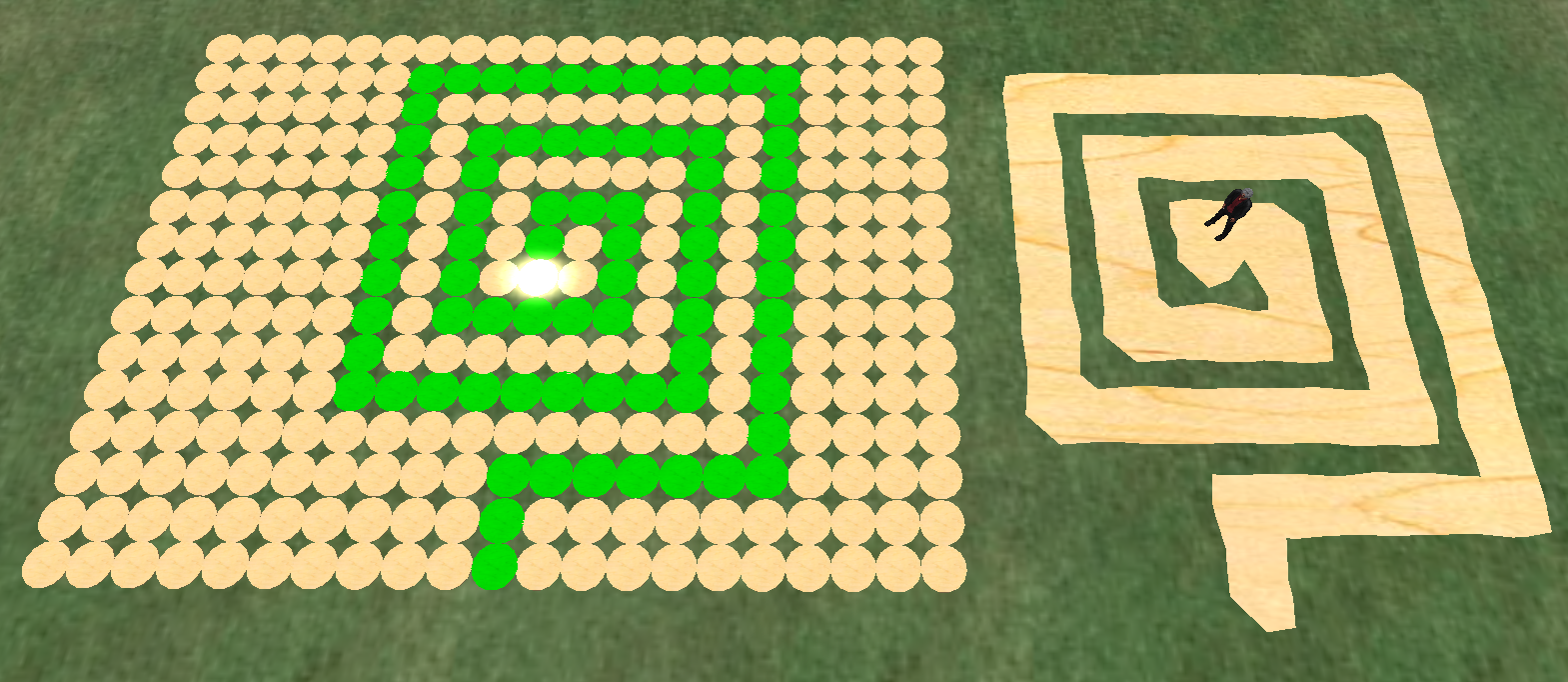
I normally use Kayaker Magic’s product on the Kitely Market for terraforming in OpenSim but for some reason I couldn’t get it delivered on Wolf Territories Grid. I intend my presence there to be very light touch so decided I would improvise instead by making a large linkset of thin 1 m diameter cylinders. All that was then needed was a little piece of code placed in the root that iterated across the terraforming linkset (TL) and set terrain height at each cylinder’s location via the appropriate OSSL command. So by orienting the TL as desired I could with a single touch create flat surfaces on the horizontal or at an incline. In theory I could even edit the height of each prim and get more sophisticated effects.

However, one thing I wanted in particular was to be able to create paths that have shallow terraformed depressions to which textured prims could be added in the depression later. A simpler approach was to use colour to denote prims where terraforming was required. I used a short touch to toggle between white and green. The height increment or decrement from the prim height is a constant value defined as a float in the object’s description field. A long touch then terraforms according to the pattern. You can, of course, restore the colour en masse via the texture option in the build menu. The example below used a value of -0.25 in the description field.

To terraform on a larger scale I created a linkset of thin box prims, each the size of the TL with the TL in the root. Each prim was oriented as desired as part of the linkset and then a piece of code used to rez the TL and have it move between each prim and adopt the orientation before terraforming locally and moving onto the next position.

I’m fairly rubbish at terraforming so looking forward to seeing if this rather basic but functional approach helps.

Reposted with a better example and then code (no error handling, use at your own peril and back up terrain first)

default
{
    state_entry()
    {
        llListen(99, "", NULL_KEY, "");//used with rezzer
    }
    
    listen(integer c, string name, key id, string msg)//used with rezzer
    {
        if (c == 99)
        {
            list l = llParseString2List(msg, ["/"],[]);
            llSetRegionPos(llList2Vector(l, 0));
            llSetRot(llList2Rot(l, 1));
            integer i;
            for (i = 0; i < llGetNumberOfPrims(); i++)
            {
                list l = llGetLinkPrimitiveParams(i, [PRIM_POSITION]);
                vector v = llList2Vector(l, 0);
                osSetTerrainHeight((integer)v.x, (integer)v.y, v.z);
            }
        }
    }
            
    
    touch_start(integer n)
    {
        llResetTime();
    }    
            

    touch_end(integer n)
    {
        if (llGetTime() <= 1.0)//short touch
        {        
            llOwnerSay("setting color");
            //get link number touched
            integer i = llDetectedLinkNumber(0);
            list color = llGetLinkPrimitiveParams(i, [PRIM_COLOR, 0]);
            vector col = llList2Vector(color, 0);
            if (col == <0,1,0>)
            {
                llSetLinkColor(i, <1,1,1>, 0);
            }
            else
            {
                llSetLinkColor(i, <0,1,0>, 0);
            }
        }
        else //long touch
        {
            llOwnerSay("terraforming");//use height of prim or value in desc for green prims only
            if (llStringLength(llGetObjectDesc()) == 0)//use prim height
            {
                integer i;
                for (i = 0; i < llGetNumberOfPrims(); i++)
                {
                    list l = llGetLinkPrimitiveParams(i, [PRIM_POSITION]);
                    vector v = llList2Vector(l, 0);
                    osSetTerrainHeight((integer)v.x, (integer)v.y, v.z);
                } 
            }
            else//use prim height modified by desc value in z, else ignore
            {
                integer i;
                float inc = (float)llGetObjectDesc(); 
                for (i = 0; i < llGetNumberOfPrims(); i++)
                {
                    list color = llGetLinkPrimitiveParams(i, [PRIM_COLOR, 0]);
                    vector col = llList2Vector(color, 0);
                    if (col == <0,1,0>)
                    {                    
                        list l = llGetLinkPrimitiveParams(i, [PRIM_POSITION]);
                        vector v = llList2Vector(l, 0);
                        osSetTerrainHeight((integer)v.x, (integer)v.y, v.z + inc);
                    }
                } 
            }  
            llOwnerSay("done");            
        }            
    }    
}

Link format for micro.blog

This foxed me for a while as I was expecting some kind of unique user-post id. The format of links to micro.blog posts is vrsimility.micro.blog/YYYY/MM/DD/first-three-words.html where first three words refers to the title. This is used for internal as well as external links, i.e. there are no equivalents of wiki-style links. Presumably there is no equivalent for tweet-style posts lacking titles.

Thoughts on assets

I’m increasingly using low poly assets from Luma Genie to populate my builds. They’re not a patch on custom-made mesh (as per Encantada plants, for example) but they’re available quickly unless you want a hi-res version and generally you can get something that approximates your need. The downside is that objects created separately like tables and chairs are unlikely to match.

I did try looking for freebies on Wolf Territories Grid but the link that automatically appears in Firestorm takes you to a spot that doesn’t have much (if anything) of that ilk. Likely it’s gone elsewhere and I should check the Welcome area for links (see below for update). I’m fairly sure there’s commercial mesh available inworld but it means yet another digital currency which I’d rather avoid. So Genie it (mostly) is.

The grid owner appears to endorse such methods as they have made a video demonstrating an alternative source, Meshly. This appears to have a more conventional experience compared to the minimalistic but highly effective Genie, somewhat akin to NightCafe which I have used for images.

As far as textures are concerned, I’m currently mostly using the OpenSim Library although there are plenty of websites I could use, plus textures licensed for export from Kitely. Leonardo.ai is another possibility as is the forthcoming withpoly.com.

Of course, I’m operating at the freebie tier where possible and may have to think again when monetisation inevitably intrudes.

Update: Inworld assets, including freebies, via the website

Loving Vincent

We were given a DVD for Christmas called Loving Vincent. This chronicles an investigation into the two months artist Vincent Van Gogh spent in the French village of Auvers-sur-Oise prior to his untimely death. It follows one of several less conventional theories as to how the artist met his end but is most notable for its beautiful rotoscope-style integration of the story with the many paintings dating to that summer of 1890.

My interest piqued, I found that there had recently been an exhibition at the Musee d’Orsay on this subject and I bought the handsome volume that accompanied it. This locates some of the paintings onto a period map of Auvers so it became possible to consider doing an OpenSim build on the topic. This is not a novel idea; there is already an excellent build of part of Arles in much the same vein on the Littlefield grid and for all I know someone may have recreated Auvers as well. Doing my own build, however, is an interesting challenge and an excellent opportunity to explore the environment that attracted so many painters, not just Vincent.

Accordingly, I have acquired an inexpensive 1km x 1km sim on the Wolf Territories Grid (WTG), half of which will be devoted to virtual Auvers. I have been resident on a number of grids over the years and they all tend to have their own idiosyncracies and that is often part of their charm. So I look forward to exploring WTG and what it has to offer in terms of developing this new build while tentatively blogging my progress here on micro.blog, another platform new to me.