The iconic water tower at Liverpool Road Manchester railway station
As ever, very provisional and much conjecture plus thanks to Ed for stimulating discussions…
Perhaps the most familiar visual record of the first railway station at Manchester is Thomas Talbot Bury’s Entrance into Manchester Across Water Street which was first published in 1831 and updated in 1833 as shown here. Curiously Bury does not feature the goods or departure station on Liverpool Road but rather focuses on the twin engineering feats of the bridges over the Irwell and Water Street that brought the railway into town on a viaduct comprising 22 arches. Between the two bridges is a ramp and a prominent water tower necessarily raised above rail level so that it could service a water crane on the southern Liverpool-bound track.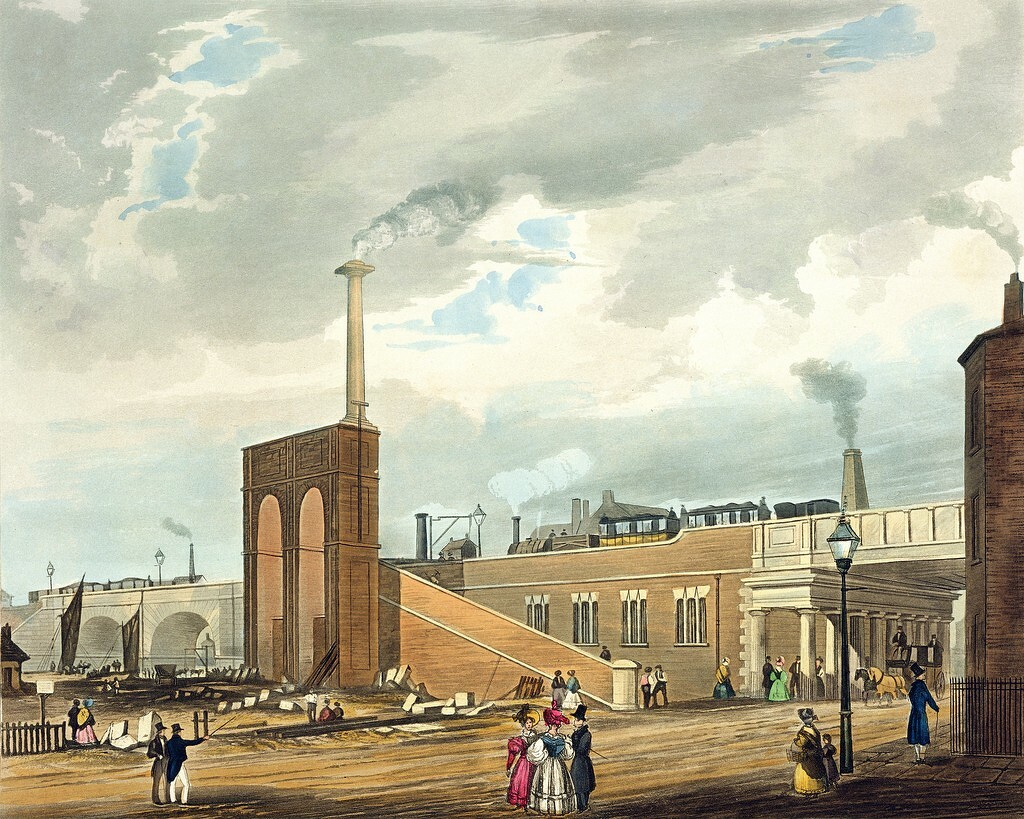
Mains water was pumped into the raised tank by means of a stationary steam engine located at ground level. The chimney was absent in the first version suggesting that other means were initially used to fill the tank if indeed it was functional at that time. The engine also drove a hay-cutting machine and the boiler supplying steam to the engine was used to pre-heat the water destined for the locomotives.
The presence of the ramp was a concession to the Old Quay Company which owned warehouses alongside the Irwell and which raised objections to the plans to bring the railway into Manchester. It provided an 18 foot roadway alongside the track as far as Ordsall Lane on the other side of the Irwell.
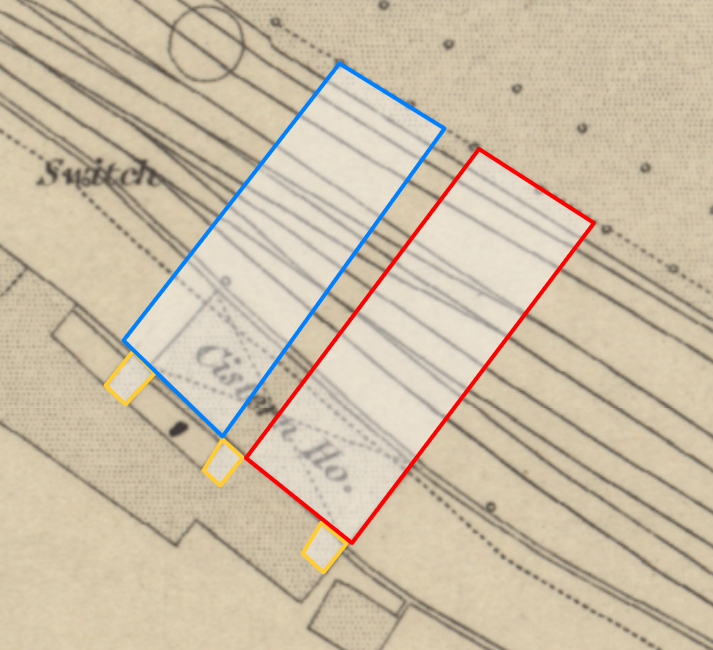
There are few if any detailed plans of the early station but a town plan from 1849 shows a cistern house, i.e. water tower, above the roadway at what is presumably the top of the ramp. Whishaw (1842) notes that this comprises four tanks and outlines the manner in which steam from a boiler (presumably also used to service the engine used for pumping and feed preparation for company horses stabled nearby) pre-heats the water in the tanks to 84F/29C.
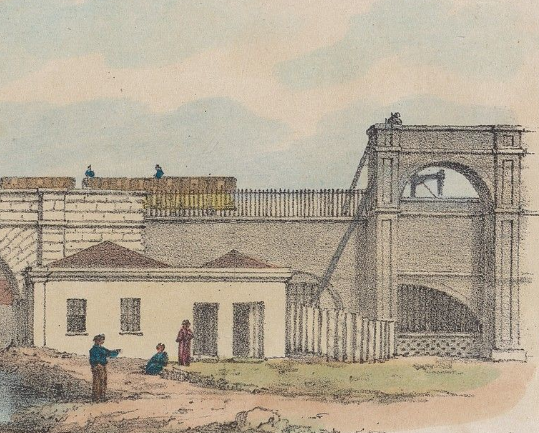
In his 1833 guide to the Liverpool & Manchester Railway, the pseudonymous Tourist published a sketch of the viaduct’s approach to the Irwell bridge. It includes the lefthand span of the original water tower and shows a low arch behind possibly with iron bars and air bricks, potentially providing ventilation for the engine, either directly or via a connection to the adjacent righthand arch (not shown) assuming they are connected and depending on the location of the engine.
What appears to be a ladder at rail level with a workman or two suggests that the expanded capacity, the cistern house, was already present in 1833, perhaps reflecting the increase in traffic on the railway. According to Thomas, in 1834 an additional boiler costing £60 was installed for the purpose of heating water, presumably to relieve the existing boiler used by the engine for pumping water and making feed. This may explain the second clear area to the left.
Detailed plans of the station are unfortunately lacking prior to the town plan of 1849 which shows the cistern house. It does not, however, show the original water tower. However, if one accepts that a ventilation space would be needed, the space with the black mark is appropriate and identifies a potential abutment (yellow) which is 5 feet wide. The space itself is 16 ft wide and, together with an adjacent central pier, span and righthand abutment, defines the location and breadth of the original water tower which corresponds closely to that of the cistern house of 44 ft in width (5 ft x3 + 16 ft x2 = 47 ft). The approximate size and location of the arches are also shown in red and blue. These are of the order of 20 ft clear span and thus curiously slightly wider than the spans of the original water tower at 16 ft. This can be seen in Tourist’s sketch.
If this supposition is correct, it would appear that the original water tower survived at least until 1849 and may have helped support the supplementary water tanks in the later cistern house. The nature of the surrounding buildings is unclear but the presence of a weighing machine suggests it may have been a warehouse (as in the original specification for the 1837 arrivals station) and/or something like a lumberyard.
Recent research
Duguid et al. (2020) give further detail of this part of the viaduct in their discussion of conservation issues surrounding construction of the Ordsall Chord, a new viaduct and bridge connecting Manchester and Salford. They relate significant changes to the southern aspect of the viaduct in the 1860s with removal of the roadway and water tower and addition of a new facade and ramp for livestock which still persists. They confirm that the area to the south was used as a dye works, a livestock market and warehouse.
According to the paper, the viaduct comprises seven brick arches with spans of around 20 ft, an exception being the arch adjacent to Water Street which was reduced in width due to a widened pier when the current bridge replaced the original in 1905. The southern edges of the five eastern arches appear to have been widened by 5-7 m, presumably in the 1860s to accommodate further track. The other two arches (as shown in Tourist’s sketch) differ significantly in having lower springings and crowns. They are also stepped back (?) compared to the others and the authors suggest this reflects their involvement in either the roadway or water tower and that they were therefore potentially structurally separate from the viaduct itself.
A copy of their archaeological research is held in the Greater Manchester Historic Environment Record and may be published in the Greater Manchester’s Past Revealed series (it is not there at the time of writing five years later).
Did the roadway and viaduct arches connect?
William Smoult’s painting of the Irwell bridge and viaduct shows a possibly truncated view of the viaduct prior to addition of the water tower but appears to confirm that the roadway arches were separate from the viaduct itself and their crowns lower. While Smoult may have had his limitations as an artist, he was a practising civil engineer so his view has potential interest.
Bury’s view appears to show brick walls under the arches of the water tower. These are not obvious in Tourist’s sketch which shows the two westernmost arches as integral parts of a facade presumably some 7 ft inside the arch. Whether these connected to the viaduct arches is unclear. It is plausible that the boiler and engine were located under the water tower and roadway; this would have a combined depth of approximately 23 ft. However, Tourist’s sketch, albeit of only one arch of the water tower, provides no evidence of this. There is no access point, no evidence of piles of fuel. Moreover, the engine was used in the preparation of feed as well as pumping water so proximity to the raw materials stored under the viaduct arches would have been necessary. This argues that there was some connection between the two sets of arches if only for a belt drive.
Possible resolution
If one assumes seven viaduct arches, each with 20.5 ft span and 6 ft pier, and compare them with three arches under the roadway as inferred from the 1849 map (shown in green in the reconstruction below), then the roadway and viaduct arches do not align. However, the overlap does allow for a door from the corresponding viaduct arch to the roadway arch which may solve the issue of access if the boilers and/or engine are located under the roadway.
The building adjacent to the Irwell shown in Tourist’s sketch matches the area shaded in the 1849 map and may have survived at least until then. Its purpose is unclear but it might, for example, provide mess accommodation for train staff.
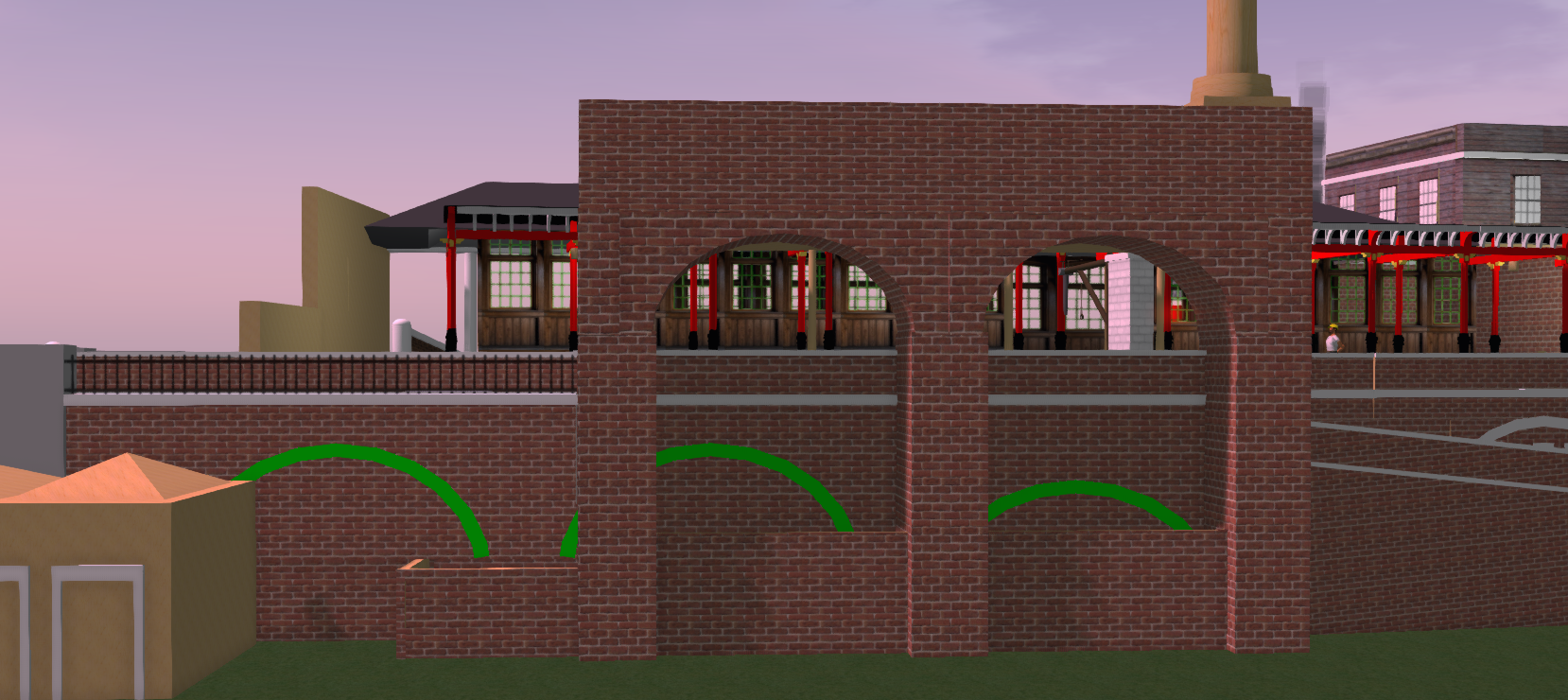
With thanks to Ed, Paul and Ant for information and discussion on Bluesky. Their interpretation may differ
15/12/2025 Added reference from Thomas (via Ed) to second boiler. 15/12/2025 Added summary of Duguid paper and discussion thereof. 21/12/2005 Added image of OpenSim build and possible resolution re access