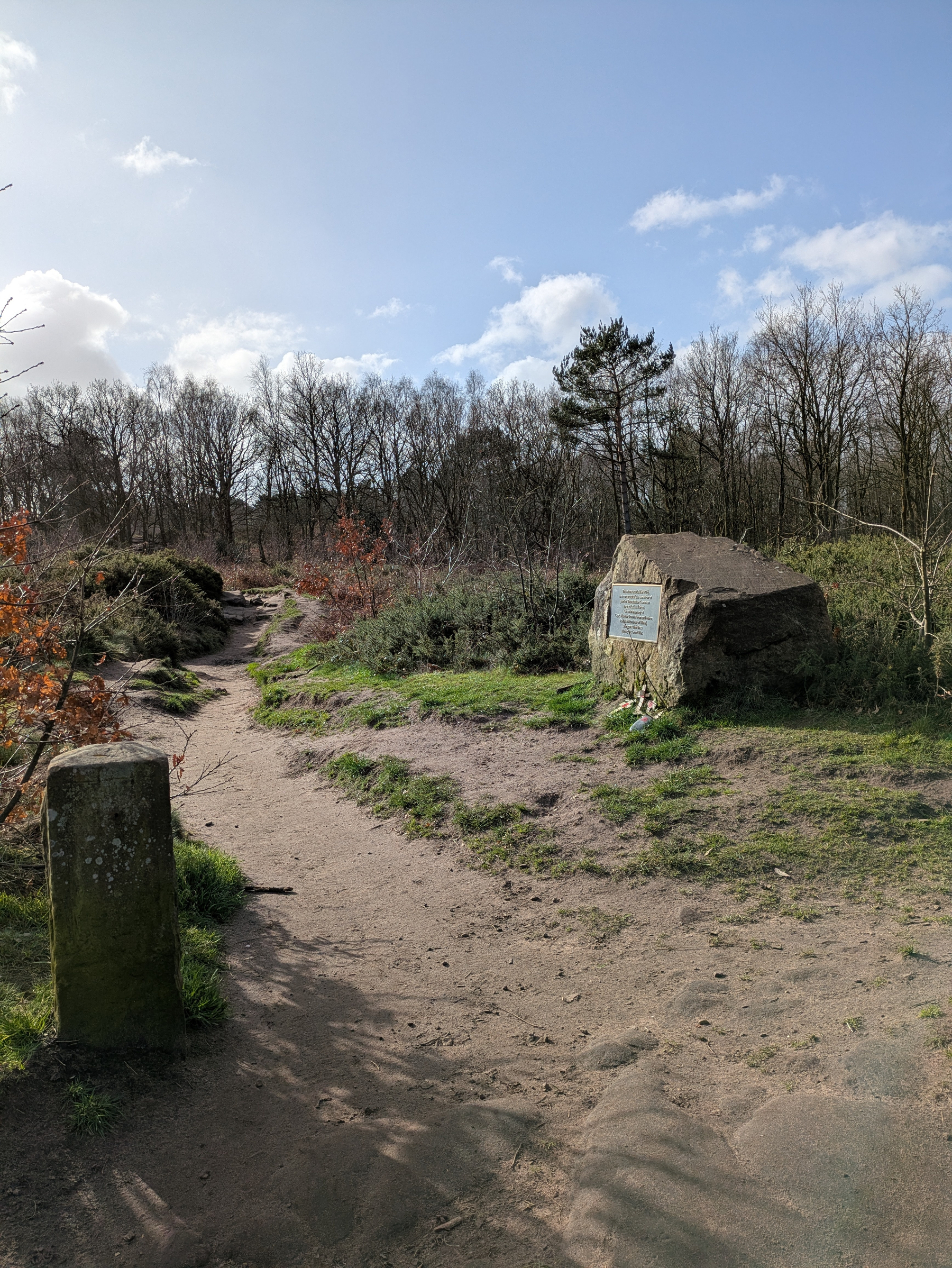
The war memorial on Thurstaston Common
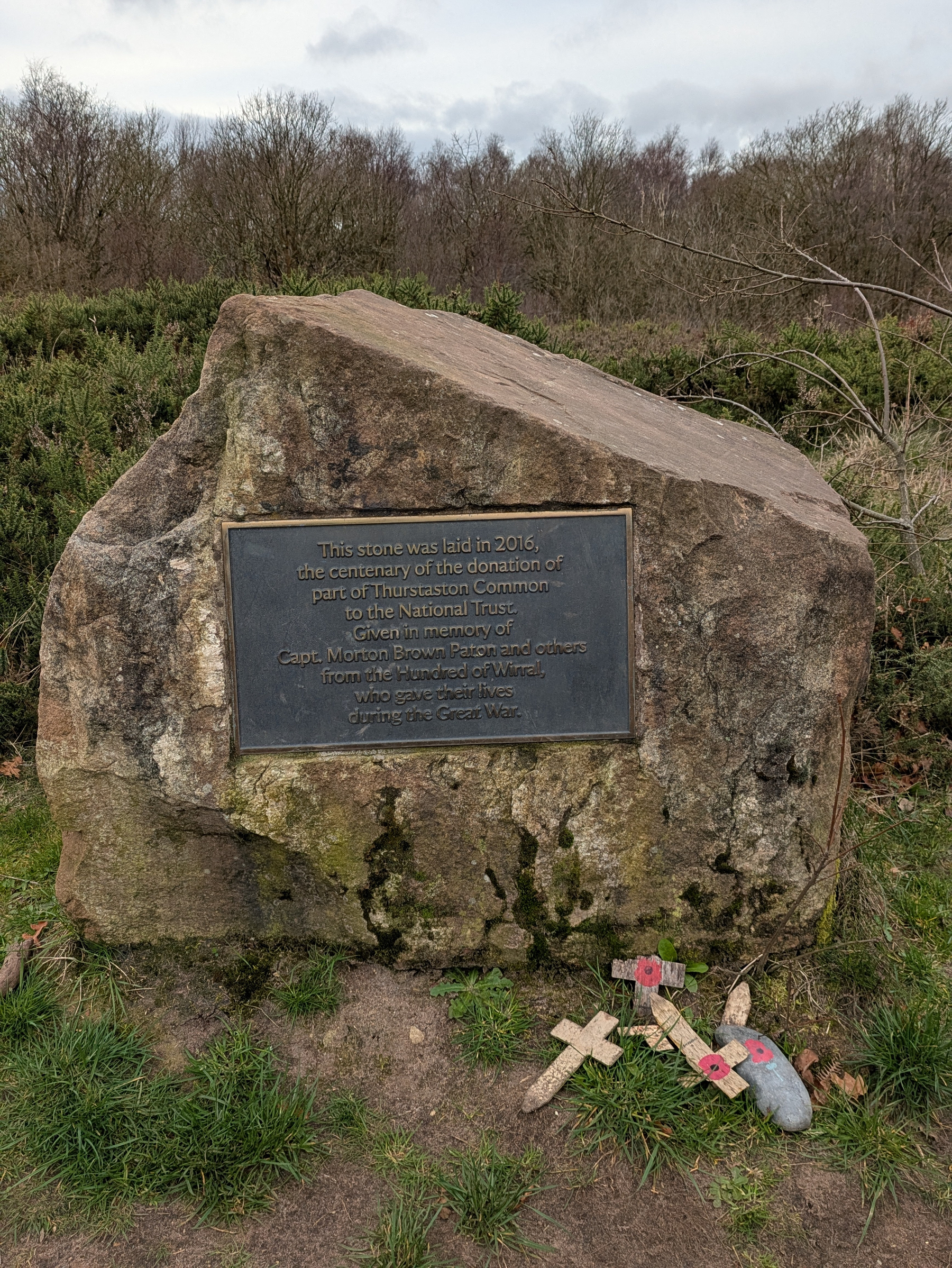
I often walk past a memorial commemorating donation of 11 hectares of Thurstaston Common to the National Trust by Alfred Vaughan Paton in 1916. A simple memorial in keeping with the setting had been mooted when the donation was first made but ultimately it came to fruition in 2016, one hundred years later. As its plaque indicates, it is in memory of his brother Morton Brown Paton who was listed missing in action after the Battle of Krithia Vineyard on 7th August 1915. Morton was particularly fond of Thurstaston according to his brother Alfred and, as the Liverpool Echo related, some thought the terrain there resembled that of Gallipoli where MB Paton sadly died.
Nottingham and education
Morton Brown Paton was born in Nottingham on June 24, 1871, the youngest of six siblings. His father was the Rev Dr John Brown Paton, a Scots nonconformist clergyman who was Principal of the Congregational Institute, a training college for nonconformist ministers, as well as the driving force behind numerous initiatives such as the National Home Reading Union and the Boys Life Brigade (and separate Girls arm) which later merged with the Boys Brigade.
His son was educated at Nottingham High School and in 1890-94 won a Carey scholarship to Balliol College, Oxford. There he read modern history and was described in the college memorial book as “quiet, solid and friendly.” He was a member of the University Volunteers so presumably received some basic military training.
On leaving university he joined the cotton business run by his brother Alfred in Liverpool (and previously by their uncle). Their office was based in Orleans House, Edmund Street, opposite the Cotton Exchange and now a Grade II* listed building. The business was highly successful with Alfred serving as president of the Liverpool Cotton Association in 1917-18. When he died, MB Paton left in his will a sum in excess of £23000, roughly £2 million in current money.
Arrival in Liverpool and Wirral
His first known address in 1901 was as a boarder on Jermyn Street in the Toxteth Park area of Liverpool. He subsequently boarded in Bidston Old Hall on the Wirral, his location in 1911 when his father died, his mother having passed the previous year. He was so taken with the historic building dating back to c1595 and its association with the Earls of Derby that he made available £500 in his will should the National Trust take it on (they didn’t).
In his spare time he followed his father’s example by immersing himself in charitable work. In Bidston he formed a cricket club for the local boys and organised the Empire Day celebrations. Slightly further afield he was vice-president of the Albert Memorial Industrial School on Corporation Street in Birkenhead which gave poor boys an alternative to the workhouse and correctional institution by teaching them a trade. He also ran the Liverpool branch of his father’s National Home Reading Union, a form of educational book club. He was president of the junior YMCA and a committee member of the Workers Educational Association.
Outbreak of War
When Germany invaded Belgium on 4th August 1914, Britain was bound by the Treaty of London to come to Belgium’s defence but first sent an ultimatum requiring that the Germans withdraw. When this was not answered by midnight, war was effectively declared the next day.
With the war going badly, additional troops were recruited as local, so-called “Pals” battalions affiliated with regular regiments, the idea of Lord Kitchener being that serving alongside people they knew would boost recruitment. Ultimately the aim was to form four new armies, each of 100000 men. The Earl of Derby famously raised four battalions for the Kings Regiment in Liverpool during August and September, the Liverpool Pals. On September 7th 700 men from Port Sunlight marched through Chester to enlist in the 13th Battalion The Cheshire Regiment.
In similar vein MB Paton joined the 10th (Service) battalion of the Prince of Wales’s Volunteers (South Lancashire) Regiment which was raised in Crosby in October and would become part of the fourth and final new army (K4).
It is worth remembering that Paton was 44 when he died the following year which is a relatively advanced age for a soldier anticipating combat duty and this may not have been his original intention. At the outbreak of war he enlisted as a special constable. However, being a keen sportsman, he was likely very fit for his age and perhaps had second thoughts as the months passed in 1914.
Given his background it is more likely that he joined as an officer and he appears in the London Gazette as having been appointed temporary lieutenant as of 23rd November 1914 at which time the battalion was still based in Crosby. In December it moved to Heswall which was conveniently close to West Kirby where brother Alfred lived on Lang Lane (he has a memorial nearby on Caldy Hill).
On 10th April 1915 the battalion was converted into the 10th (Reserve) battalion, the idea being that it would provide replacements to battalions already in action and hence depleted. Two days later, according to the Gazette, Paton was promoted to temporary captain.
In the following month of May, Paton was attached to the Lancashire Fusiliers and shipped directly or otherwise to Gallipoli where he was initially put in command of A company of the 1/6th Battalion. It is possible that he arrived in time for the Third Battle of Krithia (4th - 6th June).
Meanwhile back in London the Gazette reported that MB Paton would become a limited rather than general partner of the cotton business effective end of June.
Gallipoli
With stalemate in France, a new front in the Dardenelles offered the possibility of breaching the straits so that Allied warships could attack Istanbul, potentially removing Turkey (or, more accurately, the Ottoman Empire) from the conflict as well as opening a warm water supply route to Russia. The straits, however, were mined and mine-clearing operations could not commence until guns on the Gallipoli peninsula overlooking the straits were silenced.
Accordingly, Allied troops landed on the shores of Gallipoli on 25th April 1915 with the aim of securing in particular a high ridge overlooking the straits called Achi Baba. An intermediate objective was a small village called Krithia which had been the objective of two previous failed assaults.
The 1/6th Battalion, a Territorial Force unit from the Rochdale area, arrived on 5th May from Egypt and, after a night in the trenches, were in action the next day in the Second Battle of Krithia. There is a photo of the officers taken in Egypt from which Paton is absent so he probably sailed with other replacements, possibly to one of the nearby islands (Mudros, Lemnos) before landing at Gallipoli.
For the Third Battle of Krithia the 1/6th Battalion were supporting the Manchesters who formed the left wing of the assault. Their role was to clear and secure trenches taken by the Manchesters. This was unpleasant as well as dangerous work but probably a good introduction to combat for Captain Paton. The Manchesters attacked in two waves, the first wave capturing the nearest Turkish trench before the second wave advanced through them to the trench beyond. Their attack was successful but, as was so often the case, they were unable to hold their gains.
There is an 1/5th Battalion officer’s oral account of the action and life in the trenches. He appears to have been primarily involved in securing the firing line but was wounded while attempting to rescue an injured Manchester.
Some feel for daily life between combat can also be gained from the diary of Lt CE Cooke MC of the 1/9th Manchesters. Even some distance from the firing line there was danger from snipers, shrapnel rounds and even occasional bombs from German aircraft. Cooke himself was invalided out from Gallipolli suffering from enteric fever. A shortage of clean water, insanitary trenches, lice, unburied bodies and dense swarms of flies added to the hazards of actual combat.
As to MB Paton himself, there is little of a personal nature in the public domain other than a fragment of a blotter subsequently framed at a shop on Slater Street in Liverpool. On the blotter are the first two verses of an old Irish prayer, St Patrick’s Breastplate. There are also two photographs in uniform, one in a regulation peaked hat and one in a solar helmet prior to departure.
The Battle of Krithia Vineyard (6 - 7th August 1915)
The aim of this relatively limited action was ostensibly to extend the Allied front by assaulting the Turkish firing line and the support trench to its rear. In reality its purpose was diversionary, pinning down Turkish troops that might otherwise oppose a new landing at Suvla Bay.
As the battle name suggests, the start line was located in part along the southern edge of a vineyard to the left of the Krithia Road. In very rough terms the vineyard was about 100 m across and extended 200 m in the distance to the first line of Turkish trenches and perhaps a similar distance to the support trenches beyond. This area was allocated to the Manchesters with Lancashire Fusiliers in support, the remaining Lancashire Fusiliers having a similar task in fields and scrub extending some 200 m to the right of the road. The 1/5th to which Paton was now attached had the rightmost position adjacent to the French sector of the attack and probably including an enemy salient that protruded at an angle that would permit enfilading fire. If you wish to explore the situation in more depth, Trenchmapper provides copious maps as overlays.
The first day had seen attacks to the left of the vineyard by other troops with only limited and no substantive progress. Details of the second day’s assaults on the vineyard and beyond by the Manchesters and Fusiliers are necessarily few and lacking detail. I will focus on the 1/5th Lancashire Fusiliers.
The assault
As was usual, there was artillery bombardment and machine gunning of the enemy lines which started at 08:10 before the first assaulting force (120 men from C and D companies) went over the top at 09:40 and moved at a steady double towards their objective, the Turkish firing line F12. Quite how enemy in the salient were dealt with is unclear but there was a separate bombing party on both flanks which may have been tasked with that objective. Men who traversed the 200 m of rising ground and reached their objective would have been dismayed to find it was a dummy trench affording negligible protection from Turkish bullets. Whether it was a ruse or just an unfinished trench, those now occupying it found the ground too hard to dig in further.
Ten minutes later, the second assaulting force of 130 men went over the top. Their objective was the support trench F13 200 m beyond the F12. This attack comprised A Company (Capt AM Paton) and B Company (Capt SH Milnes). My assumption is that AM should read MB.
With the Turks perhaps anticipating this second wave and now fully mobilised, they may have met even stronger resistance especially with their colleagues pinned down in what was increasingly looking like a trap. After action reports suggest that the Turks themselves were massing for an attack and that their numbers were therefore far greater than anticipated.
There is no mention of Paton’s fate so it is conceivable that he never made it to F12. In either event Milnes led the remainder of the second wave at F12 on towards their objective, trench F13, before himself being seriously wounded and the second assault group falling back on the limited protection of F12.
Around midday, there was a Turkish counter-attack and it seems likely that those stranded at F12 fell back on their own trenches then or before and fought it off from there. In some places at least they themselves counter-attacked before once again facing a Turkish counter-attack at 14:00 which was defeated with assistance of artillery. Cooke’s diary mentions that a platoon of the Manchesters was sent to reinforce the right around 15:00. At 16:00 a final Turkish assault succeeded in taking the Allied firing trench. Despite valiant attempts to retake it, it stayed in Turkish hands at the end of the day.
While the Manchesters had notable success in holding the vineyard, at the conclusion of the battle negligible progress had been made overall albeit that the action was deemed to have served its purpose as a diversion.
Aftermath
Sporadic fighting continued for a few more days and at some stage subsequently, possibly in October, the Allied firing line was advanced to half way up the vineyard according to maps dated November 1915. This was roughly 3.5 miles from the tip of the peninsula on a front roughly 3 miles across. The landings at ANZAC and Suvla Bay further north had likewise failed to penetrate as far as the tactically significant high ground around Achi Baba, roughly 2 miles further on from the vineyard.
The overall commander General Sir Ian Hamilton was replaced in late October by Lt Gen Sir Charles Monro whose assessment of the situation was bleak and recommended evacuation. Churchill, first Lord of the Admiralty and principal sponsor of the Dardanelles campaign, was prompted to comment in typical style: “He came, he saw, he capitulated.” However, when the secretary of state for war, Lord Kitchener, carried out a personal inspection, he came to the same conclusion as Monro. ANZAC and Suvla Bay were evacuated using various deceptions to make it appear the situation was normal until the last moment and then finally the Helles sector on 9th January 1916, some 10 months after the initial landing.
Back in August, reports of MB Paton’s death were being noted in the papers just a week or so later so it seems likely that he had been seen to fall as opposed to being, say, wounded and captured. He was listed as missing in action, a sadly not infrequent occurrence at Gallipoli.
Especially warm words were recorded in one of the Nottingham papers: ‘A man who diffused sunshine wherever he went … It may be said of him that he not only died for his country, but greatly helped to make it worth dying for.’
A memorial service was held at St James' Church, Birkenhead, attended not only by family, friends and colleagues but also by young people from the Industrial School and YMCA Boy Scouts.
Without any dependents of his own, his estate was divided chiefly among his remaining siblings. However, several donations were made to charities, perhaps most notably to the Children’s Convalescent Home and School at West Kirby which survives to the present day.
His brother’s acquisition of the lands at Thurstaston from the Caldy Manor Estate Company was made the following year and the current monument placed on its centenary in 2016. The Liverpool Daily Post speculated that the land was otherwise destined for building.
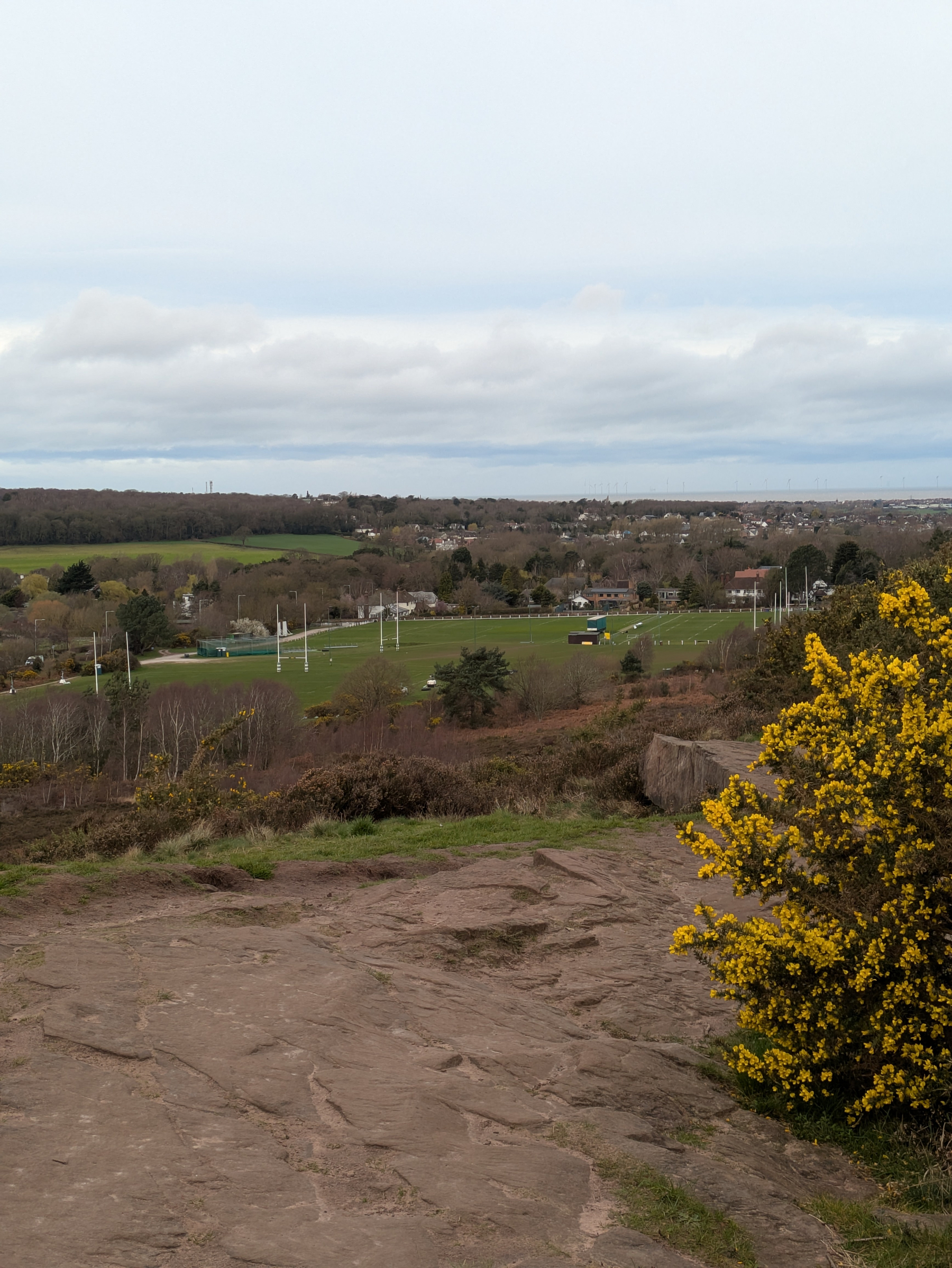
A condition of the donation to the National Trust was that Caldy RUFC (or Old Caldeians as it was then) be allowed to play rugby on the land in perpetuity. Their ground is therefore called Paton Field.
In addition to the memorial at Thurstaston Morton Brown Paton’s name also appears on the war memorial at Bidston and the Helles Memorial on Gallipoli.
Major sources
Nottinghamshire WW1 & WW2 Roll of Honour
Lives of the First World War: We Remember Morton Brown Paton
42nd (East Lancashire) Division
Gallipoli Association Diary of Private Ernest Law